Thirty Seconds, Two Ways: One Shot Collapses, Eight Shots Make a Film
Pushing a single generation to 30 seconds produces literal nothing — an orange shimmer. Composing eight 4-second shots produces a 31-second film with a plot, a consistent character, and measured motion in every cut. The film is embedded.
Raising the bar
The duration post ended with a correction: long single shots don’t crash, they quietly stop moving — coherence purchased with stillness, and a motion score to catch it. A reader’s blunt framing stuck: a drifting camera around a frozen scene isn’t video. So this post holds everything to a functional standard — does it move, does it tell, would you watch it — and takes on the real target: thirty seconds of content. Two ways.
Way one: a single 30-second shot
LTXV, 721 frames, one continuous generation. It rendered without complaint — 6.6 minutes, no OOM, and a motion score of 2.42, technically above our static threshold.
Then you look at it:

Thirty seconds of orange gradient. No fox, no forest, no scene — at more than double the model’s healthy window, generation doesn’t degrade, it evaporates. And the motion score of 2.42 is pure texture shimmer, which teaches the instrument lesson of the day: the motion metric catches stillness, but it cannot tell locomotion from flicker. It needs the contact sheet beside it. (Every instrument in this series has needed a second instrument; this is not an exception.)
So the single-shot verdict is now complete and monotonic on this card: full motion to ~5–7 s, motion collapse to ~15 s, total collapse by 30 s.
Way two: eight shots and a cut
Nothing about a commercial or an animated short is one shot — real content cuts every few seconds. So the composition experiment: a shot list with a plot, every shot inside the motion-healthy window, one locked character description repeated verbatim in all eight prompts, rendered on Wan 2.2 5B and concatenated with ffmpeg.
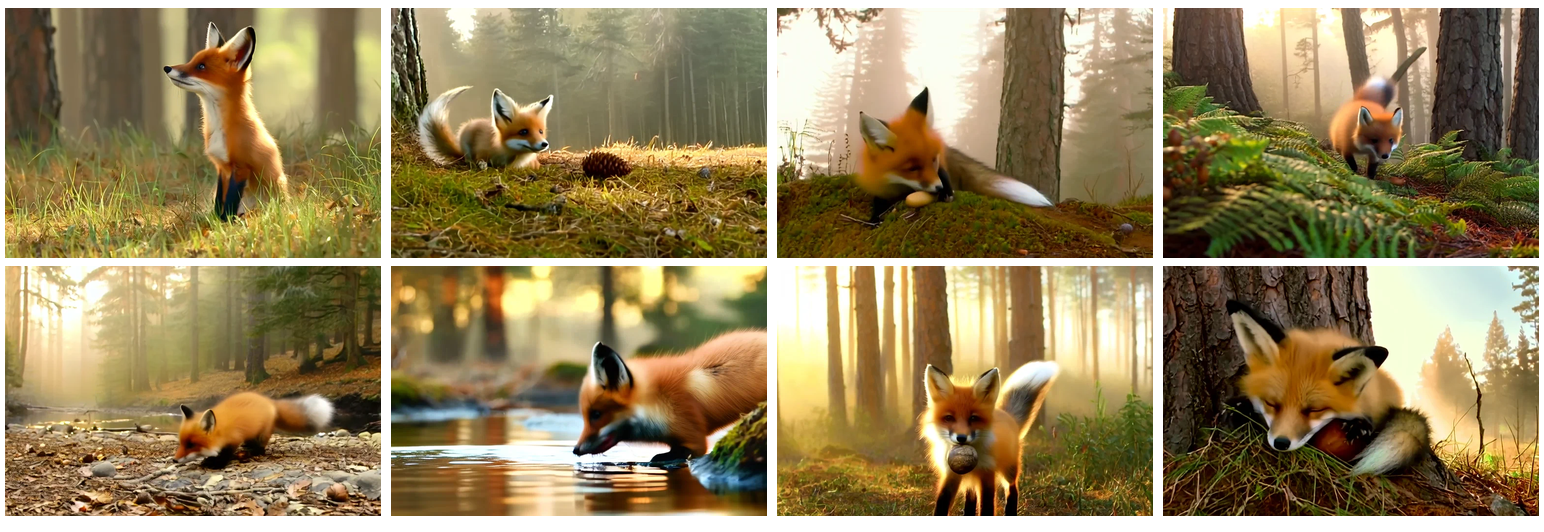
The plot, in the spirit of a certain acorn-obsessed ice-age squirrel: an acorn bonks a fox pup on the head; curiosity, pounce, downhill chase, a stream mishap, triumphant retrieval, and a nap with the prize.
The result — 31.3 seconds, 17 minutes of compute, every second of it moving:
Mid-frames from all eight shots:
The measurements
| Shot | Action | Motion score |
|---|---|---|
| 1 | acorn bonk | 2.9 |
| 2 | wide-eyed stare | 7.0 |
| 3 | pounce and tumble | 4.2 |
| 4 | downhill chase | 5.0 |
| 5 | skid to the stream | 7.0 |
| 6 | splashing | 6.5 |
| 7 | triumphant retrieval | 4.1 |
| 8 | curl up and sleep | 4.8 |
Every shot clears the functional bar — most by a wide margin. For scale: a single Wan shot pushed to just 6.7 seconds scored 1.5. Thirty-one seconds of composed video carries three times the motion of seven seconds of continuous video. Cutting is not a workaround; on this hardware it is the mechanism.
Character consistency — the known weakness of the approach — held better than expected: the white-tipped tail and oversized ears survive all eight cuts, and the pup reads as one character across the film, carried by nothing more than a repeated description string. Honest flaws, visible above: the “acorn” of shot 2 is frankly a pinecone, lighting temperature drifts between shots, and there is no audio. This is a storyboard-quality short, not a finished commercial — but it is watchable, which no single generation at this length can claim.
The recipe
The pipeline is one script and one JSON:
make-film.py
takes a shot list (character string, style, per-shot actions and durations),
renders each shot inside the healthy window with the right frame
quantization per model, and assembles the mp4. The Acorn’s
shot list
ships as a worked example — a 30-second commercial is the same file with
different lines.
The 12 GB verdict on longform: duration is not a rendering problem, it is an editing problem — and editing is cheap. Shots plus cuts gets you to any length; the per-shot motion window is the only wall that matters.
RTX 5070 12 GB, Wan 2.2 5B for shots, LTXV for the single-shot probe,
768×512, 25 steps. Motion scores via
motion-score.py.
Film and frames unretouched.